Outdoor LED screens you can read in direct sunlight
An outdoor LED screen is built for two things an indoor display cannot handle: brightness that beats direct sunlight, and an ingress rating that survives rain, frost and wind. GMITTER MEDIA delivers digital billboards, facade screens and LED signs including the technical design, structural report, installation and service.
Our digital billboards and facade screens sit on steel structures backed by a report from a certified structural engineer. Warranty and post-warranty service included.
Why an outdoor screen is not just a bigger television
An outdoor LED screen is an LED display engineered for direct sunlight and year-round weather. Three parameters separate it from an indoor screen: brightness measured in nits, the IP ingress rating, and the way the screen is cooled and reached for service.
A typical indoor display runs at around 1,000 nits. On a sunlit facade that leaves a grey rectangle where not even a logo is legible. Outdoor LED screens therefore work in the range of several thousand nits and dim automatically through an ambient light sensor, so that after dark they neither blind the neighbourhood nor waste electricity.
The second difference is structural. An outdoor cabinet is sealed and ventilated so that water cannot get in and heat can get out. That is why GMITTER MEDIA also supplies everything you never see on the screen itself: the load-bearing structure, the structural report, a dedicated protected power supply with an electrical inspection report, and service access.
How many nits a screen needs in direct sunlight
Brightness is the decisive parameter of any outdoor LED screen and depends on where the surface faces and whether the sun hits it. GMITTER MEDIA specifies brightness from the orientation of the surface and the viewing distance, not from the catalogue maximum. These ranges are our starting point during a site survey.
| Location of the surface | Indicative brightness range |
|---|---|
| Indoors and shop windows facing a mall passage | roughly 800 to 1,500 nits |
| Outdoor surface in shade or under a canopy | roughly 2,500 to 3,500 nits |
| Facade with no direct sun, north-facing | roughly 3,500 to 5,000 nits |
| Digital billboard and any surface in direct sun | roughly 5,000 to 7,000 nits |
The largest outdoor screen in the GMITTER MEDIA portfolio stands on Hodonínska street in Bratislava. It measures 8 × 5 metres, which is 40 m² assembled from 60 cabinets, and runs at 6,000 nits. During the day it works at full output; after dark the automatic dimming brings it down to a level that does not disturb the surroundings.
Weather resistance: what an IP65 rating actually means
The IP rating states how well a screen is protected against dust and water. IP65 is the standard for outdoor LED screens: fully dust-tight and resistant to water jets. The catalogue figure is only the starting point, though. On every outdoor installation GMITTER MEDIA handles the four things such projects most often fail on.
Temperature and cooling
An outdoor cabinet has to survive frost and a baking facade alike. An overheated module loses brightness and colour accuracy, so rear ventilation and the gap from the wall are resolved in the technical design, not improvised during installation.
Wind and structural load
A large screen behaves like a sail. We design the supporting structure for the wind load of the specific site and every installation comes with a report from a certified structural engineer. Without it the building authority will not approve the surface.
Power and surge protection
An outdoor screen needs its own protected supply, surge protection and an initial electrical inspection report. The inspector cannot issue it without a protocol determining external influences, so we arrange that in advance.
Service access
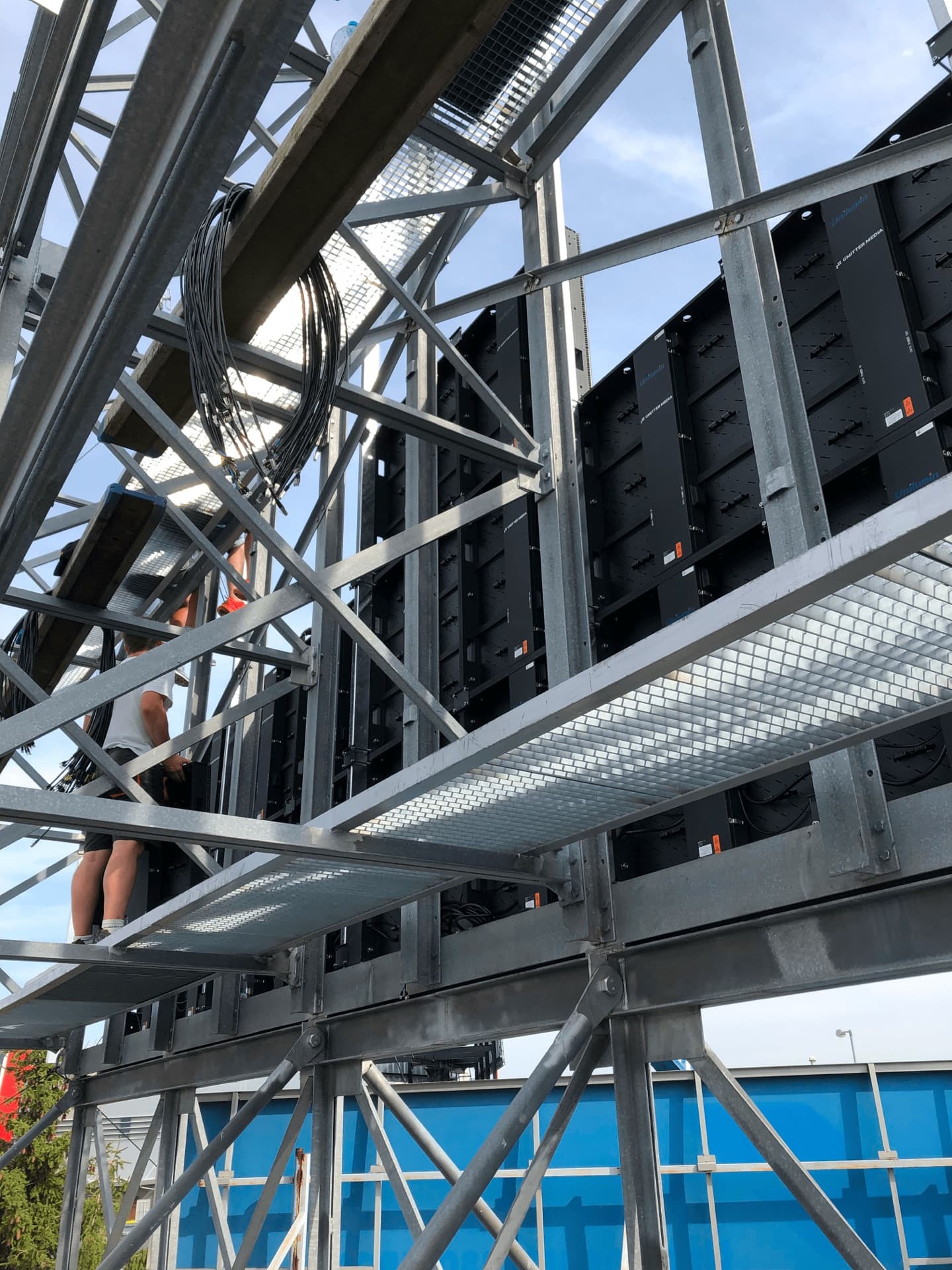
Modules do get replaced eventually. If the screen cannot be reached, every repair means a crane and a road closure. For larger surfaces we therefore design a service walkway behind the screen or front service access.
Types of outdoor LED solutions
Digital billboard
A large-format screen by a road or on a rooftop that replaces a printed billboard. Instead of one artwork it rotates several campaigns, so you sell the same surface to several advertisers at once.
Facade LED screen
A screen built into a facade or mounted above the entrance to a venue. It turns the building into a landmark and carries your own message at the same time: opening hours, promotions, the current offer.
LED sign and totem
A smaller free-standing surface at an entrance, in a car park or in front of a store. It replaces the illuminated board that has to be re-lettered every time the offer changes.
Stadium and outdoor venue screens
Outdoor scoreboards and screens for sports grounds and open venues, where legibility from the back row and year-round durability matter as much as the content itself.
City and transport displays
Information screens for municipalities, transit stops and public spaces. One network of surfaces, with content scheduled and changed centrally, without driving out to each screen.
Mobile outdoor LED poster
A folding outdoor LED poster rated IP65 with a 600 × 2,025 mm display area. You set it up with no construction work, fold it away after the event, or join several units into one continuous surface. A complement wherever a fixed screen would not pay off.
Design, permits and installation
Above a certain size an outdoor LED screen counts as an advertising structure and cannot simply be hung on a facade. GMITTER MEDIA takes over the whole technical package so you do not have to run the permit process yourself.
Site survey
We establish where the screen will be seen from, how the sun hits it during the day and where the supporting structure can be anchored.
Technical design and structural report
We specify the size, pixel pitch, brightness and supporting structure. The structural report is issued by a certified structural engineer.
Permit process
We prepare the documents for notifying or permitting the advertising structure and deal with the building authority and the property owner.
Installation
We erect the steel structure and the screen, including whatever access equipment the height calls for, and connect it to the power supply.
Handover and inspections
You receive a working screen with a handover protocol, an initial electrical inspection report and a trained operator.
Documented outdoor installations
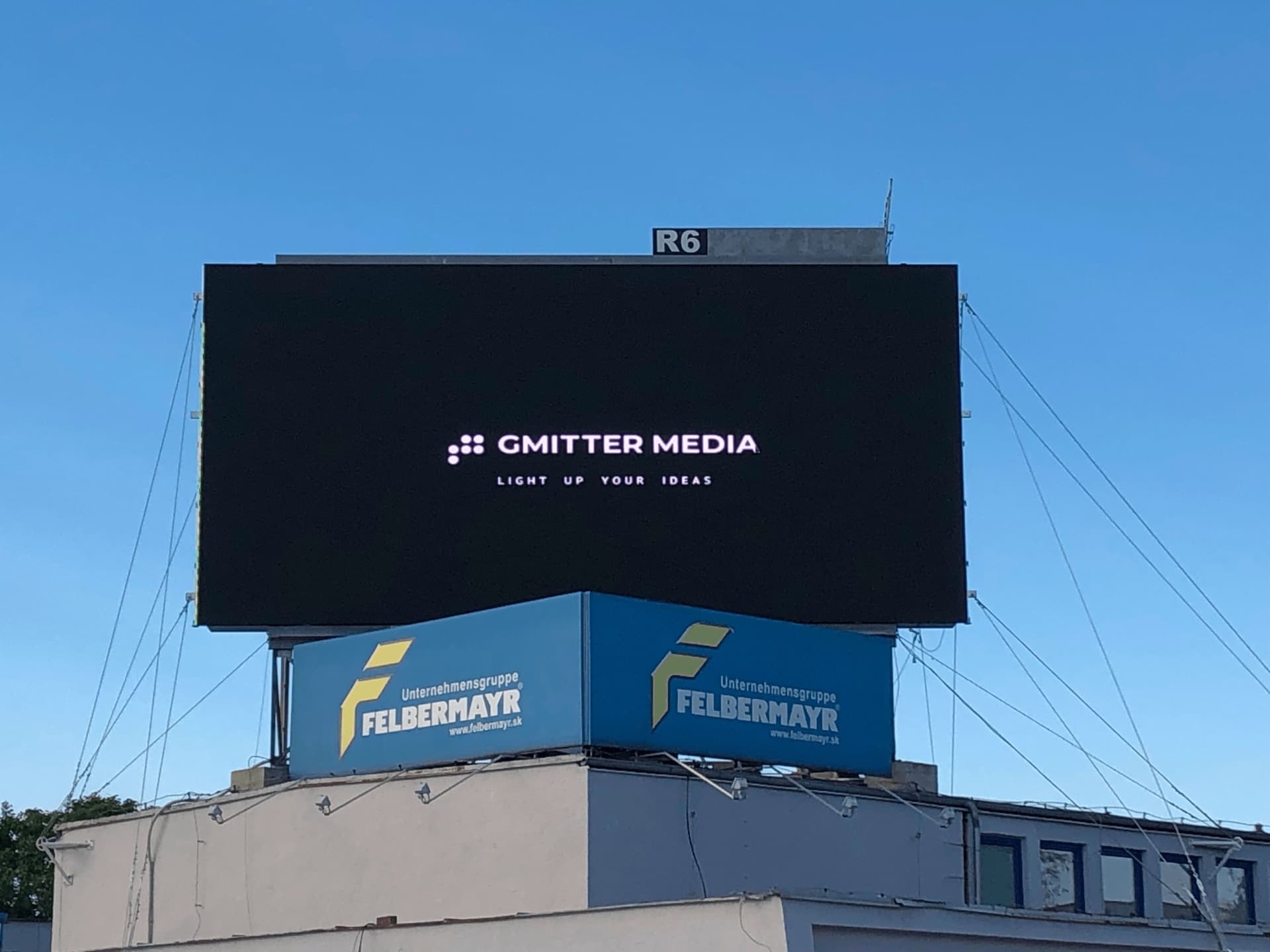
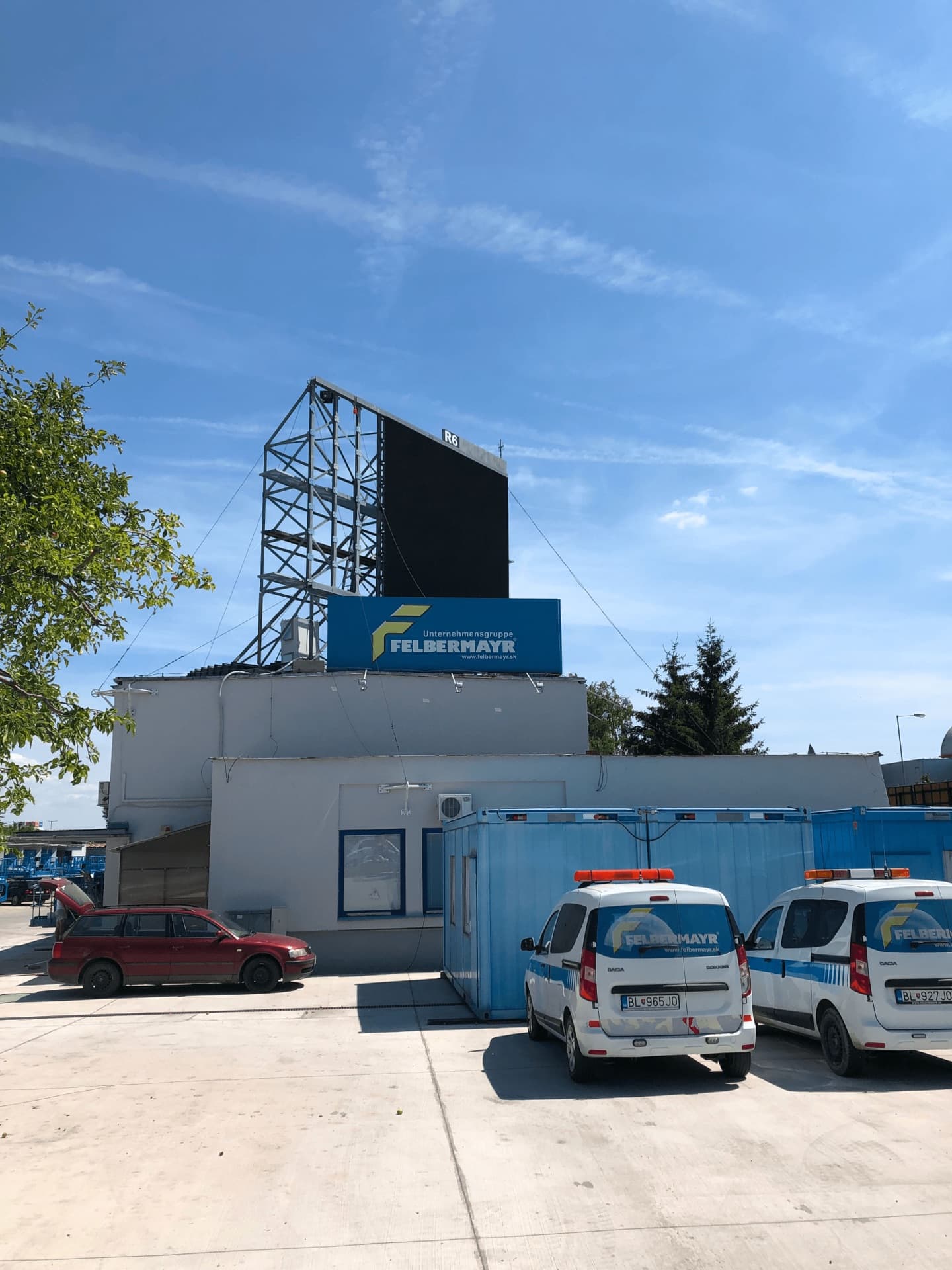
GMITTER MEDIA built a digital billboard on a steel structure on the roof of a commercial building in Bratislava. The surface is visible from the adjacent road throughout the day, the installation was carried out at height, and the structure includes a service walkway behind the screen so a module can be replaced without a crane.
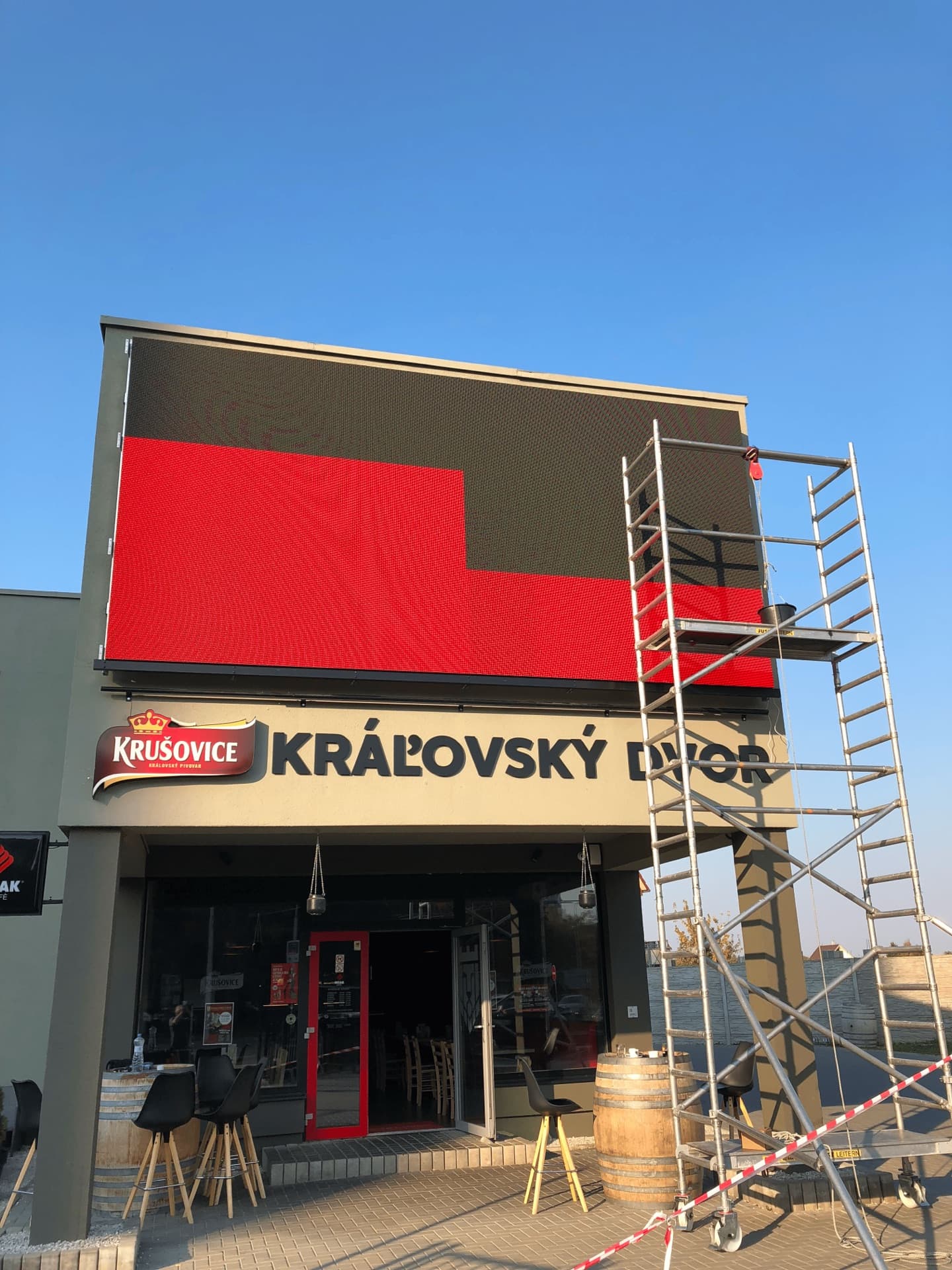
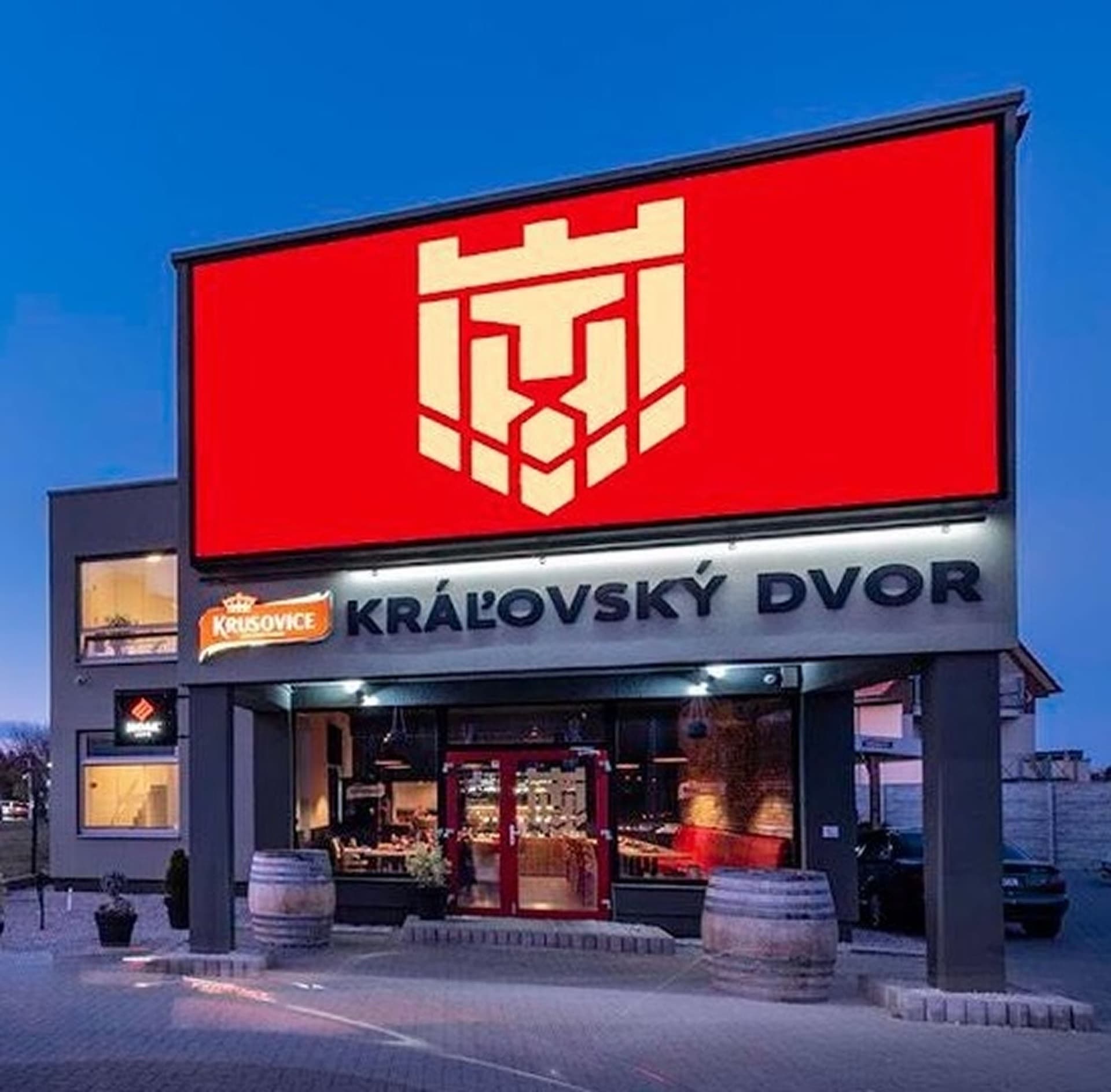
The second installation is a facade LED screen above the entrance to the Kráľovský dvor venue. The image is legible in full daylight and after dark, when the screen becomes the main light source of the whole building. The largest outdoor surface in the portfolio is an 8 × 5 metre screen on Hodonínska street in Bratislava, assembled from 60 cabinets on the roof of a three-storey building.
Service, warranty and post-warranty care
GMITTER MEDIA provides warranty and post-warranty service. On an outdoor screen that is not a formality: the surface runs every day in rain, frost and direct sun, and the only thing that really counts is how fast a module can be swapped.
Every installation ships with spare modules and we train your operator on the content system, so you change content remotely instead of driving to the screen. A service call takes one phone call to +421 915 81 81 83.
From site survey to first power-on
- 1
Consultation
We talk through where the screen should go, who will be looking at it and from what distance.
- 2
Site survey
We come to see the surface, its orientation towards the sun, the anchoring options and the available power supply.
- 3
Proposal and quote
You get a proposed size, pixel pitch and brightness together with a quote for the complete job including structure and installation.
- 4
Design, permits, installation
We arrange the structural report, the documents for the building authority and the installation itself, including the electrical connection.
- 5
Handover and service
We hand the screen over with inspection reports and operator training, then service it throughout the warranty.
Frequently asked questions
Let's take a look at your facade
Tell us where you are considering a screen and how large the surface is. We will arrange a site survey and within 24 hours of it you will have a proposed solution and a quote.
Book a free consultation


